ERC MIRACLE-AD

Multi-modal Imaging for Retinal Analysis at Cellular Levels in Early Alzheimer’s Disease

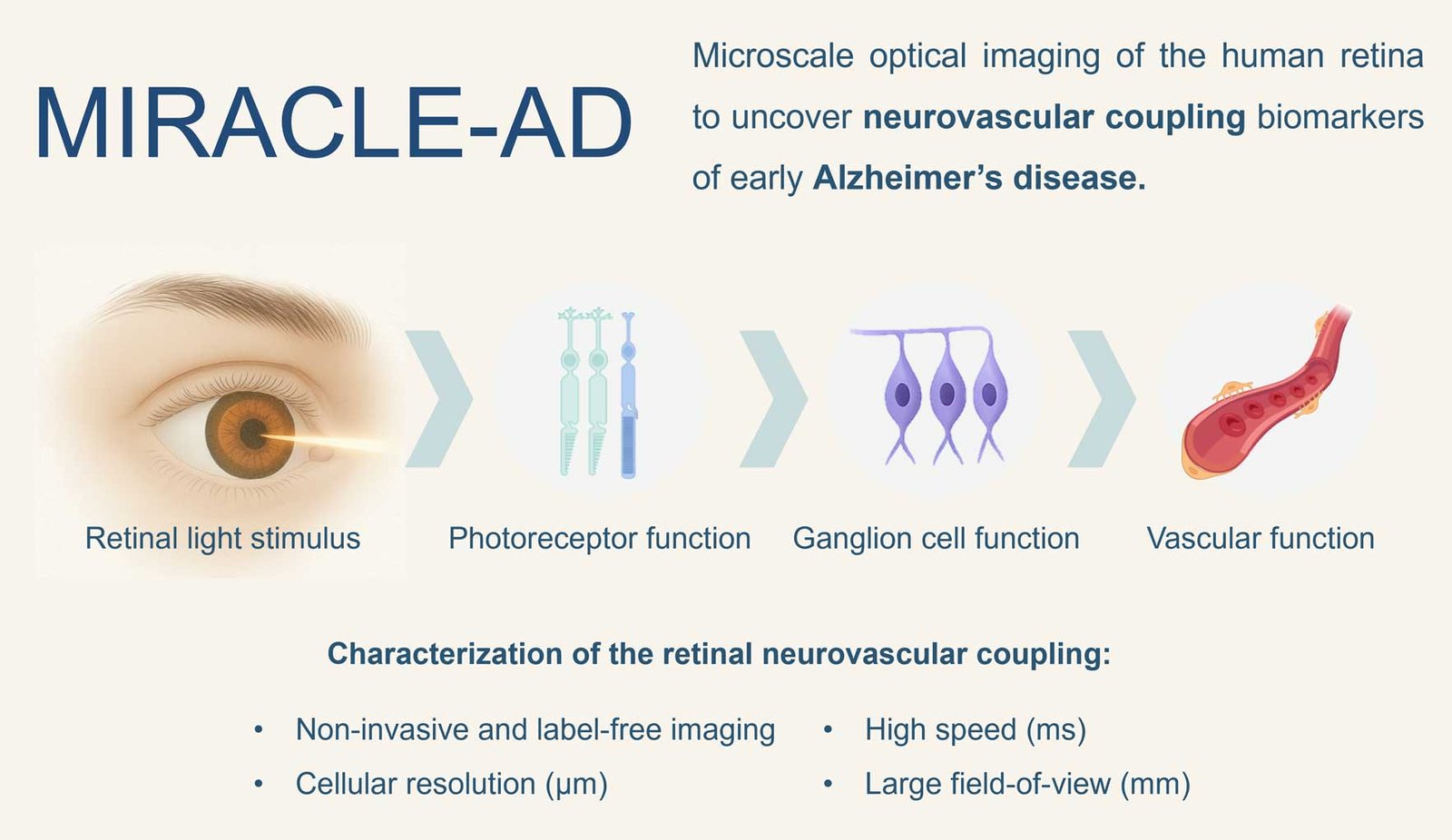
Funded by the European Research Council, MIRACLE-AD investigates how neurovascular coupling is organized at the cellular scale in the human retina and how it becomes altered in early Alzheimer’s disease.

Neurovascular coupling regulates blood flow to match the metabolic demands of neuronal activity. Its dysfunction is an early feature of Alzheimer’s pathology and is thought to contribute to disease progression. Because the retina is the only optically accessible part of the central nervous system, it provides a unique opportunity to probe these mechanisms non-invasively in humans at micrometric resolution. MIRACLE-AD aims to quantify how neuronal activation and microvascular responses interact in space and time, and to determine how this interaction is modified in early disease.

Scientific Objectives

Map neuronal activation from photoreceptors to ganglion cells following controlled light stimulation

Measure microvascular responses associated with localized neuronal activity

Construct spatio-temporal cartography of retinal neurovascular coupling in vivo

Identify quantitative signatures of early neurovascular dysfunction in Alzheimer’s disease

Methodological Strategy

MIRACLE-AD integrates two complementary imaging modalities developed within the group. Full-Field Optical Coherence Tomography provides wide-field interferometric imaging of neuronal functional responses with nanometric phase sensitivity. Adaptive Optics Rolling Slit Ophthalmoscopy enables high-speed phase-contrast imaging of vascular walls and red blood cell dynamics across extended retinal regions.

By synchronizing these platforms within coordinated acquisition schemes, the project captures neuronal and vascular activity at micrometer and sub-millisecond scales. This multimodal framework enables direct measurement of the spatio-temporal relationship between neuronal activation and hemodynamic regulation in the living human retina.

Scientific Perspective

By establishing integrated neuronal and vascular functional imaging in humans, MIRACLE-AD positions the retina as a quantitative model for investigating early neurovascular dysfunction in neurodegenerative disease. The project seeks to define reproducible retinal biomarkers reflecting alterations of neurovascular regulation in Alzheimer’s disease.

Get In Touch

Interested or need more details? Leave us a message and we’ll get back to you shortly.

    Support

    Logo
    Logo
    Logo
    Logo
    Logo